Posts

Impurity and the Disposition of the Heart- Mark 7

Image
  Song of Solomon 2:8-13;  Psalm 45:1-2, 6-9;  James 1:17-27;  Mark 7:1-8, 14-15, 21-23 Our readings today play off of each other in an interesting way. First, we have the Song of Songs, which is also called the Song of Solomon. It’s a bit of an odd book. If you read it outside of the context of the Bible, you might not see why it should be in the Bible. It seems to be a kind of love poem. And at times it is a bit risqué. Some Jewish children weren’t allowed to read it until they were thirteen because of some of its sexual content. It doesn’t even really talk about God. … A second century Rabbi, Rabbi Akiva, was asked by his students if the book should be in the Bible at all. He replied,  “Heaven forbid that any man in Israel ever disputed that the Song of Songs [is holy], for the whole world is not worth the day on which the Song of Songs was given to Israel, for all the Writings are holy, and the Song of Songs is the Holy of Holies” (Mishnah Yadaim 3.5). [1] ...

Do buildings and bodies matter?

Image
  1 Kings 8:1,6,10-11, 22-30, 41-43 ;  Psalm 84 ;  Ephesians 6:10-20 ;  John 6:56-69 The Church has always taught the importance, and even the sacredness, of creation. We haven’t always lived up to that teaching, but the teaching is ancient, nonetheless. The Early Church faced the Gnostics (a complicated and diverse movement) who believed that the material world was evil and that we had to learn to be freed from this material ‘prison’. They even denied that Jesus had a physical body because they couldn’t imagine a divine being dirtying themselves by getting mixed up with physical matter, and the bodily functions that would come along with that. So, for them, Jesus only ‘seemed’ human. To them, he was a kind of hologram produced for our benefit, but not a real human being. The Early Church fought this Gnostic tendency. They asserted that Jesus did have a physical body, and that his physical body was resurrected and ascended into heaven. They asserted that God created ...

David brings the Ark to Jerusalem

Image
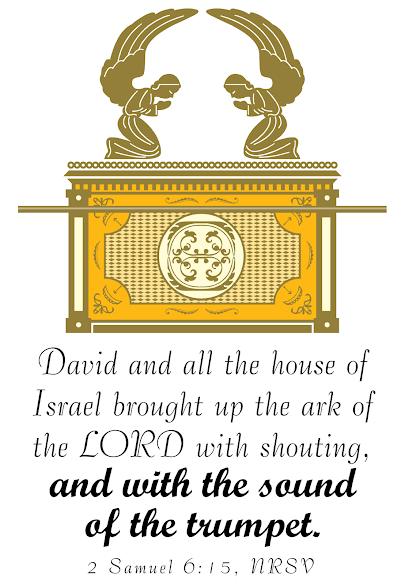
  2 Samuel 6:1-5, 12b-19; Psalm 24; Ephesians 1:3-14; Mark 6:14-29 We are continuing to look at King David’s story this week. Last week we looked at how David was anointed as King of all Israel, how he united the people of Israel, and established Jerusalem as the capital city. … In our reading today we see David bringing the Ark of the Covenant to the city he has recently established as the capital. We have also looked at the idea that humanity was created to have a kind if dominion, a rule, over creation as they reflected God’s image into the creation. (An idea I heard from Bishop Robert Barron). Some even see their God-given task as being to spread Eden- to govern all of the earth under God, and under the direction of God’s good, created order. They were to be kingly shepherds who govern creation. This kingly rule was lost at the fall, when the couple trusted a creature (a serpent) rather than God. God has been trying to reconstitute this call. At one time through Noah, and the...

David is accepted as King- 2 Sam 5

Image
  2 Samuel 5:1-5, 9-10; Psalm 48; 2 Corinthians 12:2-10; Mark 6:1-13 Today, we are continuing our series looking at King David. Last week we read about David receiving the news that King Saul had died, which opened the way for David to step into the role as king. There were still obstacles, though. While David was anointed King over the tribe of Judah and settled in Hebron with his family, Saul’s son, Ish-Bosheth, was made king over Israel through the support of the commander of Saul’s army. This leads to a kind of civil war. Eventually, through battle and politics, and misguided loyal men who were willing to assassinate Saul’s son, David eventually is anointed king over not just Judah, but all of Israel. And this is where we are today in our reading. All the competing claims to rule have been silenced and the tribes recognize David as their king. … David meets with the elders of the tribes of Israel and makes a covenant with them before God, and he is anointed King of all the trib...

David laments over Saul and Jonathan- 2 Samuel 1

Image
  2 Samuel 1:1, 17-27;  Psalm 130;  2 Corinthians 8:7-15;  Mark 5:21-43 We are continuing with our series following King David, and today he actually becomes King because Saul has died. We skip over quite a bit to get us here. Last week we looked at the battle between little David and Goliath. This is when David steps into his role as a warrior. He becomes famous for battling against the enemies of the people of Israel. As David’s fame grew, so did King Saul’s jealousy. When returning from defeating Goliath the people were celebrating and we read,  “the women sang to one another as they celebrated, ‘Saul has struck down his thousands, and David his ten thousands’” (1 Sam 18:7). One of David’s tasks in the royal court was to play music for Saul, to calm him. While playing for him, King Saul twice attempts to kill him by throwing a spear at him. This wouldn’t be the only occasion he tries to take David’s life, but in the future he is warned with enough time to e...

David vs Goliath- 1 Sam 17

Image
1 Samuel 17:1a, 4-11, 19-23, 32-49;  Psalm 9:9-20;  2 Corinthians 6:1-13;  Mark 4:35-41 We are continuing with our King David series, and today we have the most famous story about David- the battle between David and Goliath. Even people who have never picked up a Bible know about this story. Last week we heard God’s comment to the prophet Samuel when he was looking at Jesse’s sons to find the new king-  “Do not look on his appearance or on the height of his stature, because I have rejected him; for the Lord does not see as mortals see; they look on the outward appearance, but the Lord looks on the heart” (1 Samuel 15:7).  Against expectations, David is chosen, the youngest of his brothers, who they didn’t even think to bring along with them. Last week I mentioned that this is a theme we see throughout the Bible. Abraham and Sarah, the elderly couple who were not able to have children, have a child that will in turn lead to the nation of Israel. Moses, a runaway...

David is anointed King to replace Saul- 1 Sam 15-16

Image
  1 Samuel 15:34 - 16:13; Psalm 20; 2 Corinthians 5:6-17; Mark 4:26-34 In 1887, Lord Acton once wrote to an Anglican Bishop saying,  “Power tends to corrupt, and absolute power corrupts absolutely. Great men are almost always bad men…”  There is truth to this. … But, I prefer the way Dallas Willard corrects this. He prefers to say that ‘power exposes corruption’. The more powerful you are, the more likely it will be that the corruption within you will be exposed to the world and negatively influence the people around you. To hold great power you have to have great character. This is an important teaching to understanding when we look at Saul. Last week we looked at how the people rejected God’s leadership and asked to have a king like the other nations, and how wanting to be like the other nations was never a good thing. God was not pleased by this, but permitted it. The king that God chose, through Samuel was Saul. Saul seemed to start out okay. He was tall and handsome...